"Ayear ago, I got announced, and now I’m back in Vegas,” Alba Larsen tells me over scrambled eggs and bacon at the Wynn Las Vegas.
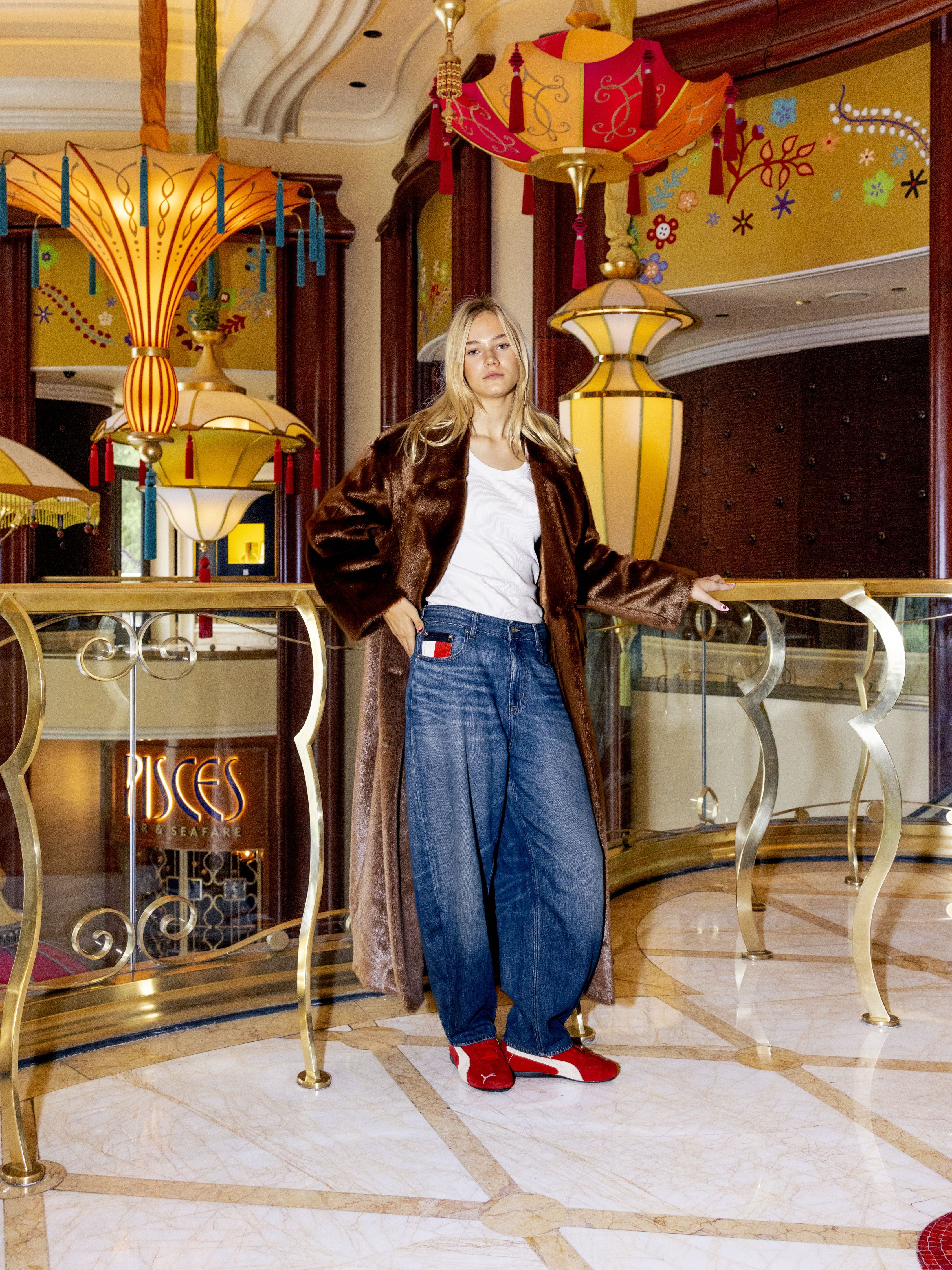
It’s 9:30 a.m. on the Tuesday ahead of the Las Vegas Grand Prix, the last race on the F1 Academy schedule. Larsen, looking polished, if tired, in a white long-sleeved shirt, barrel-cut jeans, and red PUMA Speedcat sneakers, flew 15 hours from Milan a few days before. After our chat, she will head to the Virgin Hotel for hours of filming for Netflix’s F1: The Academy. Then, from 2 a.m. to 4 a.m., she will have a chance to walk the grand prix circuit, her first opportunity to familiarize herself with the track. “I feel like it’s both been more than one year, because so many things have happened, but at the same time, it’s gone by so fast.”
This is the life of a 17-year-old race car driver: there are the ups and downs that come from driving 140 miles per hour through distant locales and, of course, those that come with being a teenager.
The whirlwind began in March when Larsen pulled up to the start line at her first F1 Academy race with no expectations. She was both one of the youngest drivers and one of the least experienced, since she had only transitioned from karting to single-seater formula racing cars a few months earlier.
But Larsen needed no learning curve. At that first race in Shanghai, she qualified P3 and finished the race at P4.
That attracted interest from big name teams from the start; Larsen remembers encouragement from Jock Clear, head of the Scuderia Ferrari Driver Academy, on the track in Shanghai. That proved to be a happy portent: This summer, Ferrari formally signed Larsen to its training program for 2026. Just 17, Larsen will race in Rosso Corsa on next year’s grid.
“For me, it’s the most iconic team,” Larsen says, smiling faintly, still a bit stunned by her good fortune. “Being able to be a part of that is super special.”
For Larsen, it all began as a pandemic hobby. “I played handball my whole life, since I was three years old, but I couldn’t do that during lockdown because it was a contact sport,” says Larsen. Since karting is no-contact and outdoors, it was fair game, so when her friend Luca’s dad invited her and her sister to race at the local track in Roskilde, Denmark, 11-yearold Larsen jumped at the chance to move and compete. (Luca’s dad, by the way, is Jan Magnussen, who raced in Formula 1 in the 1990s.) After that first day, Larsen was hooked.
“I just fell in love with the adrenaline rush you get when you drive so close to the ground,” she says. “Even though in the beginning, I wasn’t going very fast, it just felt crazy to be able to push the gas and get some G-force.”
During that summer of 2020, Larsen spent almost every day at the racetrack. Magnussen happily gave her pointers (and sold a used kart to her dad so she could get serious about the sport). His older son, Kevin Magnussen, who was then competing in Formula 1, soon became a mentor to Larsen. “They got me into it,” she says. “And then when I got into racing other people, I’m very competitive, so the competitiveness in the sport really hooked me.”
Larsen began to win karting tournaments in Denmark, and started to race across Europe, including in Sweden and Italy. In 2023, she won the FIA Girls On Track Rising Stars program; at the end of 2024, she raced a single-seater for the first time, finishing P6 and winning “Top Rookie” at the F4 Championships in India. That’s how she got into F1 Academy, the female-only, Formula 4 championship program led by Susie Wolff, and was catapulted into a different kind of adolescence: 20-hour f lights to unfamiliar cities and days spent in a simulator, modeling shoots and fashion week appearances, and oh so many interviews for Netflix and profiles, all in service of driving a race car as fast as possible on some of the world’s most famous circuits.

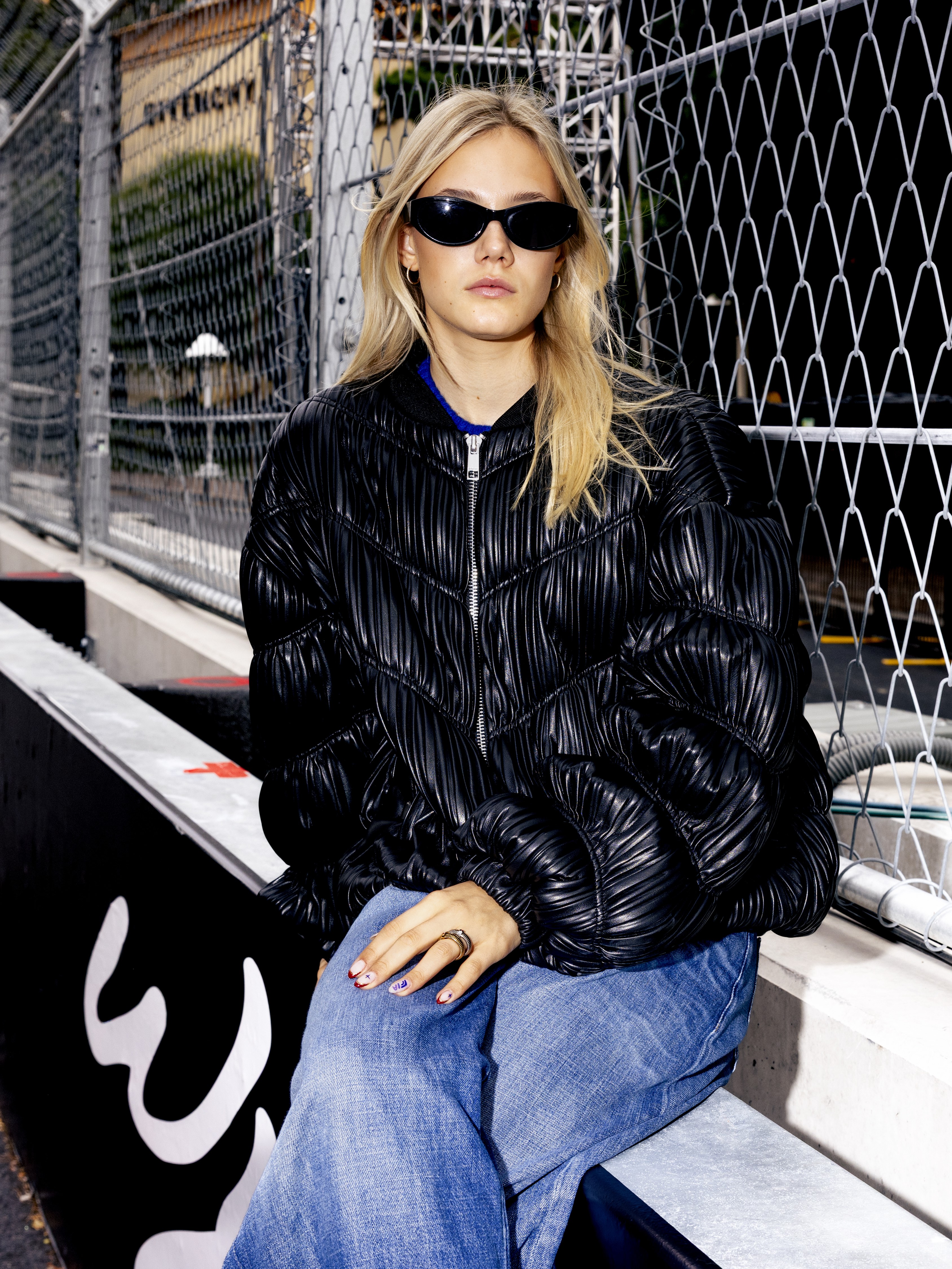
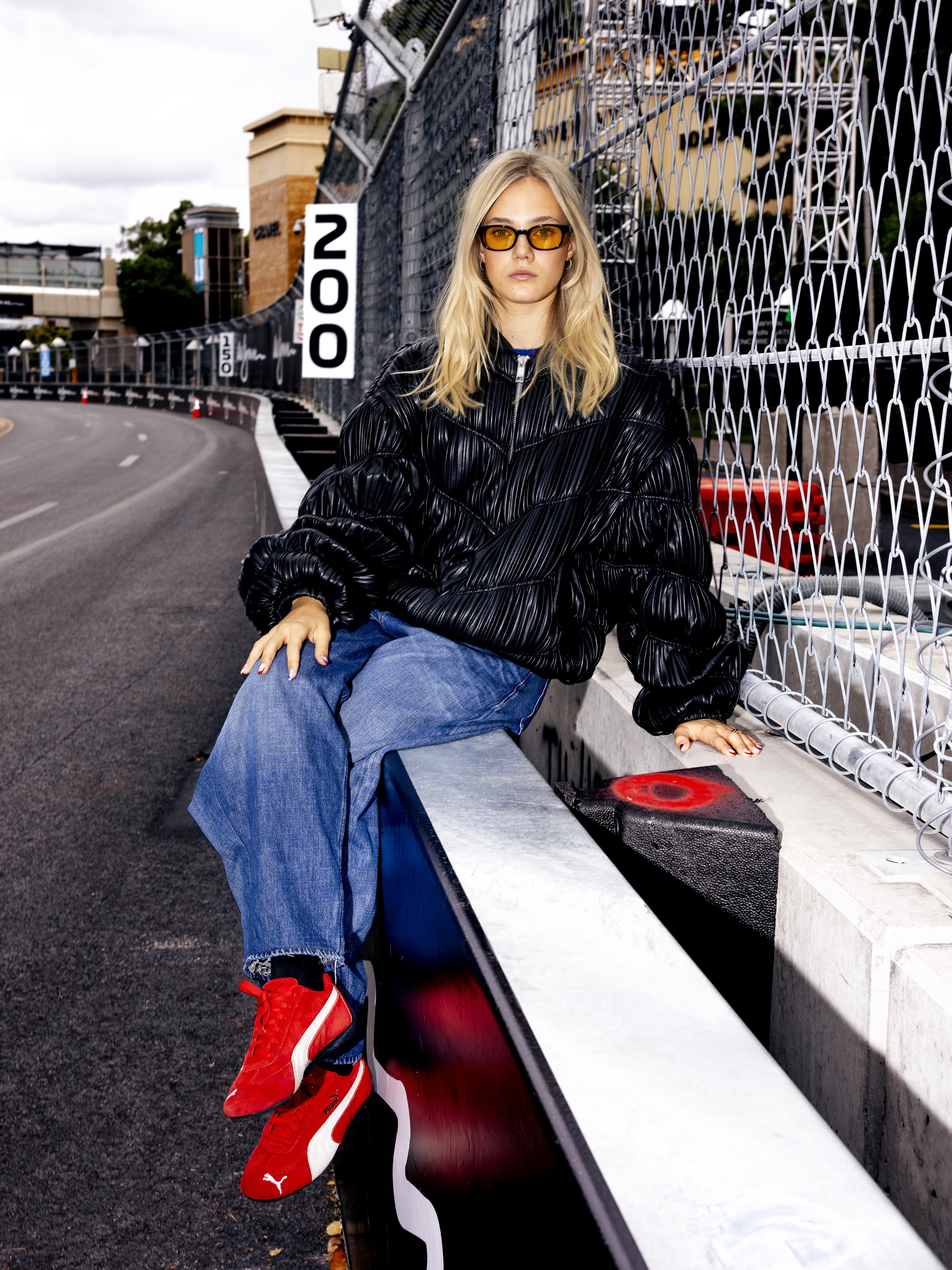
Larsen is tall and slight, with a quiet, selfcontained confidence. As she poses for photos in a floor-length fur coat, perched on a concrete barrier on the Strip as cars speed by, she seems to take it all in stride. Although maybe she’s more dazed than unfazed. As Larsen hops down and her mom ties a sweatshirt around her neck to prevent her from catching a cold, Larsen mutters to herself, “It’s time to go to bed at home.” In Las Vegas, it’s only 10 a.m. She has a long 24 hours ahead.
Yet even after a year of training under the spotlight, she’s still a teenager. Like many quiet teenagers, she lights up when talking about her friends. In this case, the friend group she’s describing are the world’s fastest female drivers. As she tells me who are the funniest and the sweetest girls on the grid, she gestures animatedly, showing off a glittery manicure in red, blue, and gold. Her mom had painted Larsen’s nails specially for the Las Vegas race with her number, 12, an FIA symbol, and tiny stars.
A team ethos is built into F1 Academy, which has six teams of three competitors each. That’s key for Larsen, a lifelong teamsport athlete. While she and her fellow MP Motorsport drivers Maya Weug and Joanne Ciconte compete hard on the track, of course, they genuinely regard each other as teammates. “We have long breaks, between practice and qualifying or lunch and the race, so we spend a lot of time in the box together,” says Larsen. “It’s usually a lot of fun, even though we’re also very serious when we come into the race weekends.”
Traveling across the world to race on unfamiliar tracks under enormous pressure, all while filming interviews for the next season of F1: The Academy, can feel surreal. Larsen, Weug, and Ciconte have managed to find some normalcy together. They have special traditions, like a sushi lunch on simulator days before each race. In their downtime, they find other ways to compete; Larsen loves padel, while Ciconte, who also joined F1 Academy at just 16, always wants to play the Imposter game from TikTok.
The broader F1 Academy cohort helps to normalize the experience for each other, too. When Chloe Chambers turned 21 in June, they were in Montreal; the drivers all went axethrowing to celebrate her birthday.
For Larsen, who is so competitive that she would occasionally get in trouble during P.E. class, the environment of exceptionally competitive girls is a welcome counterbalance to the surreality of her life. (She proudly tells me that she and Doriane Pin, the F1 Academy reigning champion, won the axe-throwing contest.)
“It’s super nice to have my teammates and the other girls, because I bond with them in a way that I didn’t with the boys on my team in British F4,” says Larsen. “You get some friends on track, which I was missing from handball, where we’re girls playing together.”
Larsen has worked to foster that environment for female drivers through Alba Academy, a series of events that she has held at kart tracks for girls and women interested in racing. She chooses her words carefully as she explains the value of these racing meetups; it’s impressive for a teenager to so succinctly tease out the nuance of when and why gendered sports can be beneficial.
“When girls do it together, they don’t get scared by boys being too aggressive in the beginning,” she says. “Then they will have the confidence to go out and beat the boys as well.”
That is how she sees F1 Academy. While she enjoys an all-female training environment, Larsen doesn’t hope for an all-female series; she wants to race (and win) in Formula 1. “Racing is one of the only sports where it’s mixed-gender, and I think that’s super cool,” she says. “The muscle is the machine.”
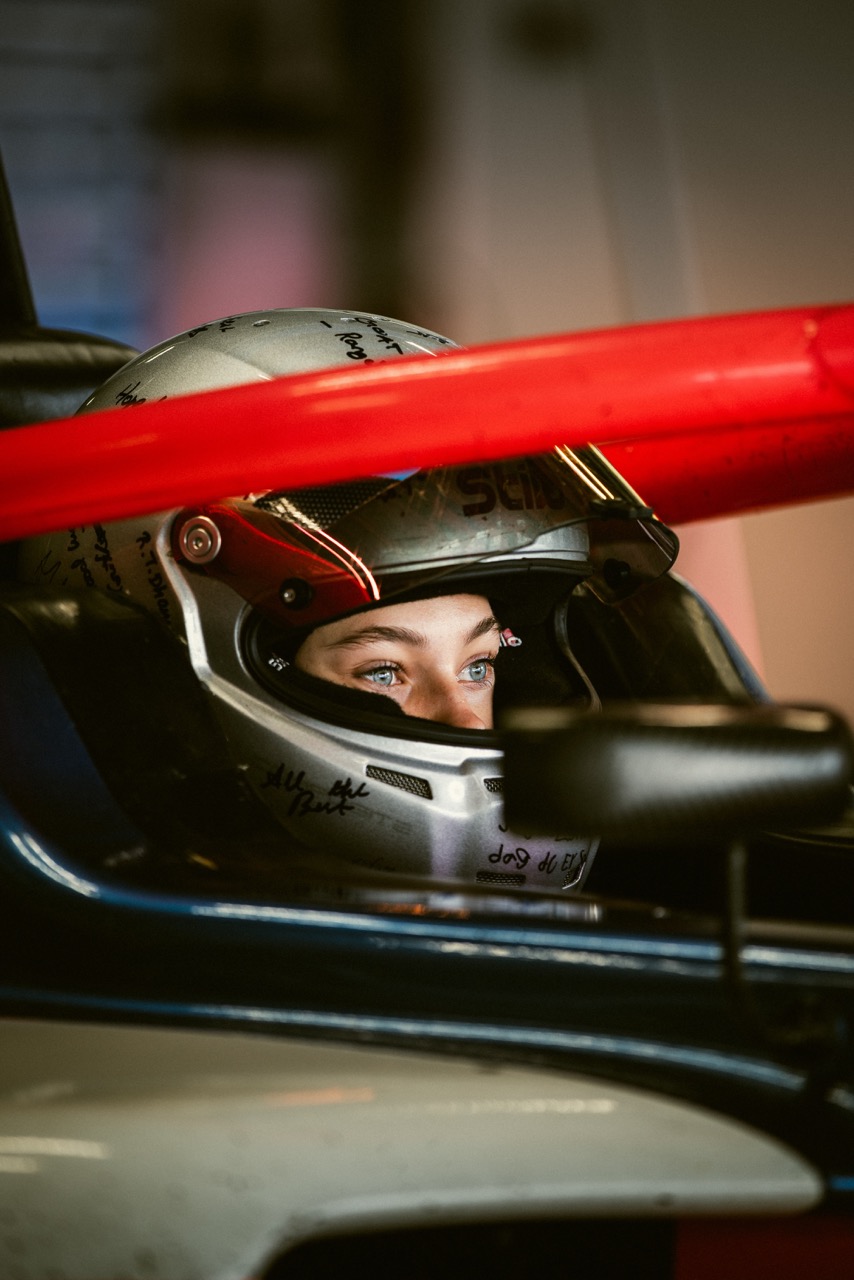
Alba prepares for a few laps of testing.
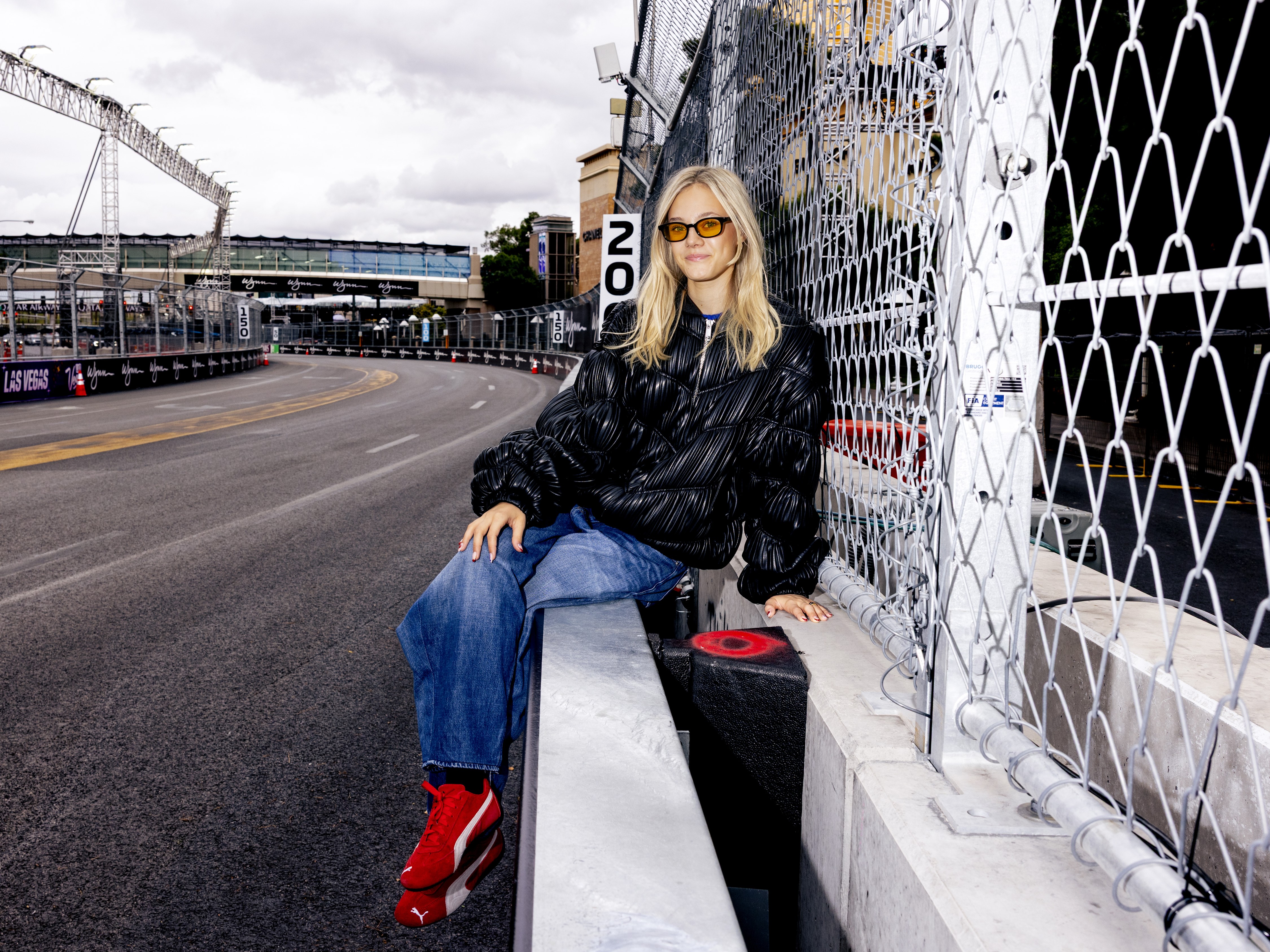
Alba Larsen on the track ahead of the 2025 Las Vegas Grand Prix.
Racing those machines is expensive, though, and Larsen is paying her own way. When Weug and Ciconte go sightseeing in Jeddah or Shanghai, Larsen often has to beg off because of media interviews or shoots, including for her sponsor, Tommy Hilfiger.
“They help build up Alba’s brand, and the bigger Alba’s brand is, the more she can race,” says Lars Hemming Jorgensen, a family friend and Larsen’s manager. For the past year, Jorgensen and both of Larsen’s parents have worked full-time building the business of Alba; her mother, Camilla, a makeup and nail artist, travels with her to every race, where she both gets Larsen camera-ready and acts as a stand-in mom for the other younger girls, chaperoning outings in unfamiliar countries. They are all making sacrifices to bet on her future. Larsen is, too: She hasn’t been able to have a sleepover with her friends from home in months, and paused her education after finishing ninth grade this spring. It is considerable pressure for a teenager, although Larsen insists she doesn’t mind.
“It’s been a lot,” says Larsen, maintaining a polite remove.
Her life is moving at a dizzying pace. Five days after training with Ferrari at Maranello, Larsen leans against the railing of a bridge, looking out at a decidedly less glamorous Italy: the grand canal at the Venetian in Las Vegas. She stands under fake sunny skies, but her mind is on the uncharacteristically drizzly weather outside; she has never raced the Las Vegas circuit and a wet track will only make it more difficult.
The season isn’t quite over, but Larsen is already thinking about next year. As a driver in her second year in F1 Academy, she hopes to make it onto the podium, where the teenager would pop a bottle of sparkling water while her older competitors pop champagne.
She is looking forward to training in a red racing suit as a member of team Ferrari and to staying at the Ferrari racer house in Maranello — if she can convince her mom to give her permission.
And she’s excited to finally get her driver’s license. Larsen may have driven a single-seater 140 miles per hour on the Singapore street circuit, but so far, she has only driven the family station wagon around a parking lot.