IN PARTNERSHIP WITH

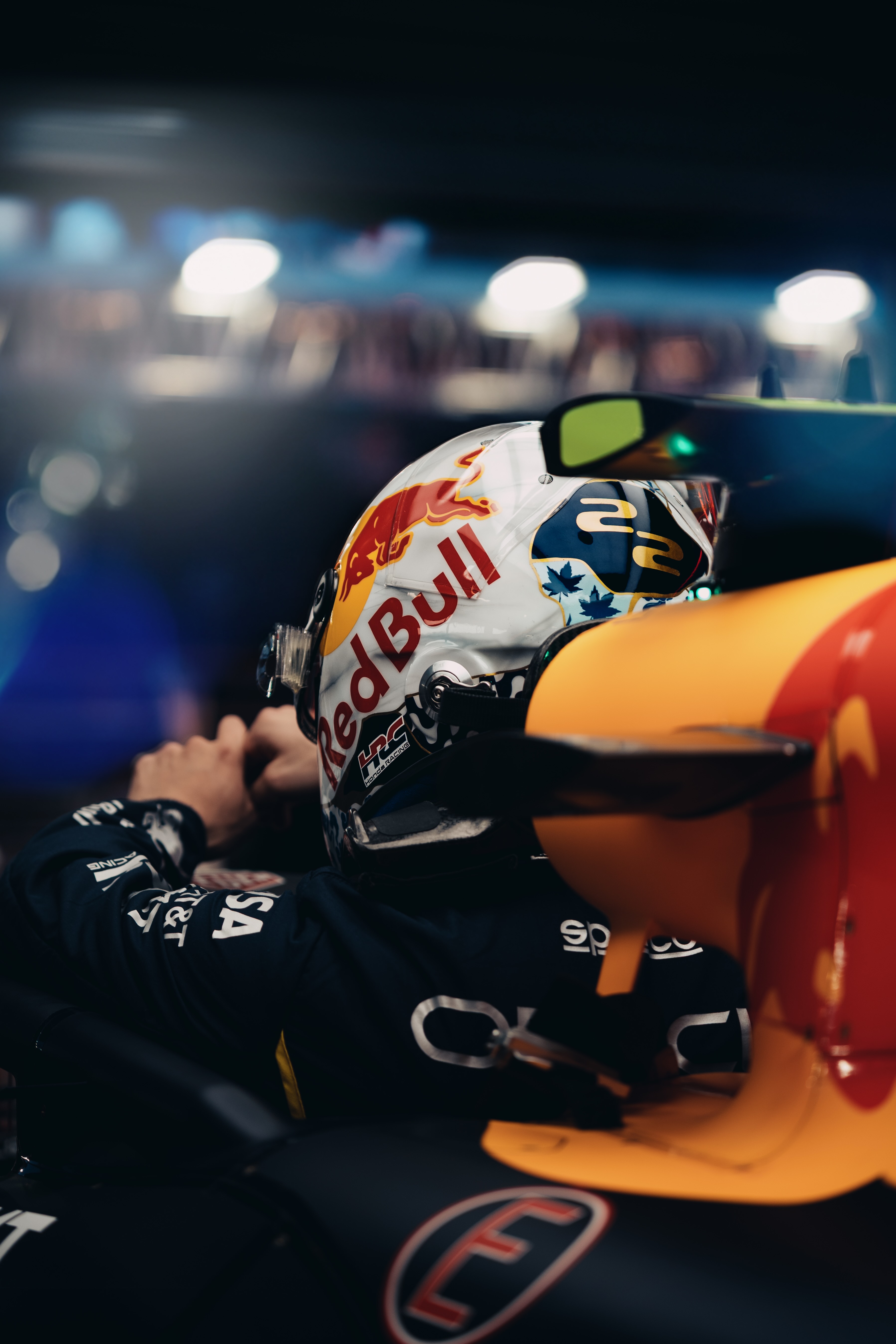
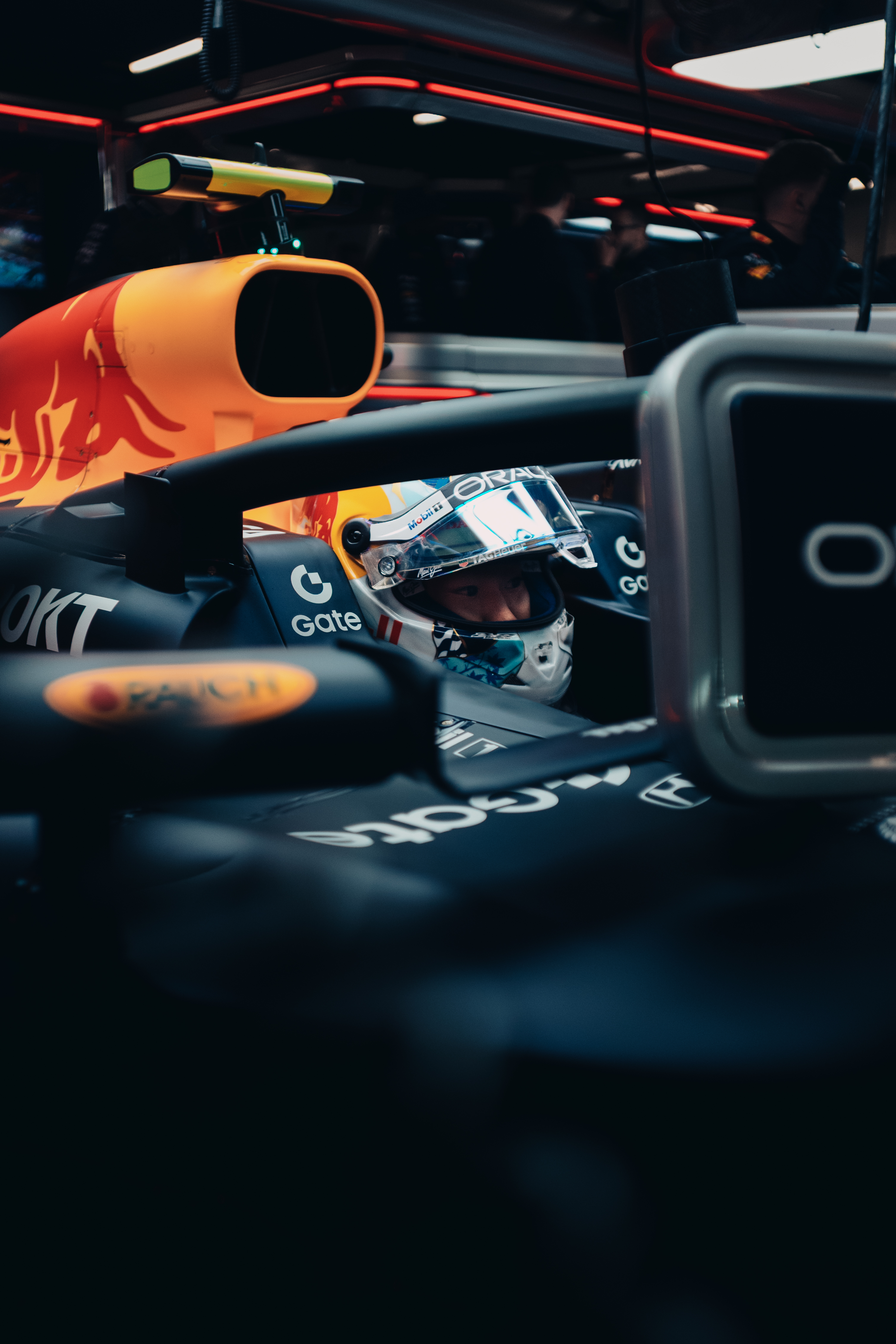
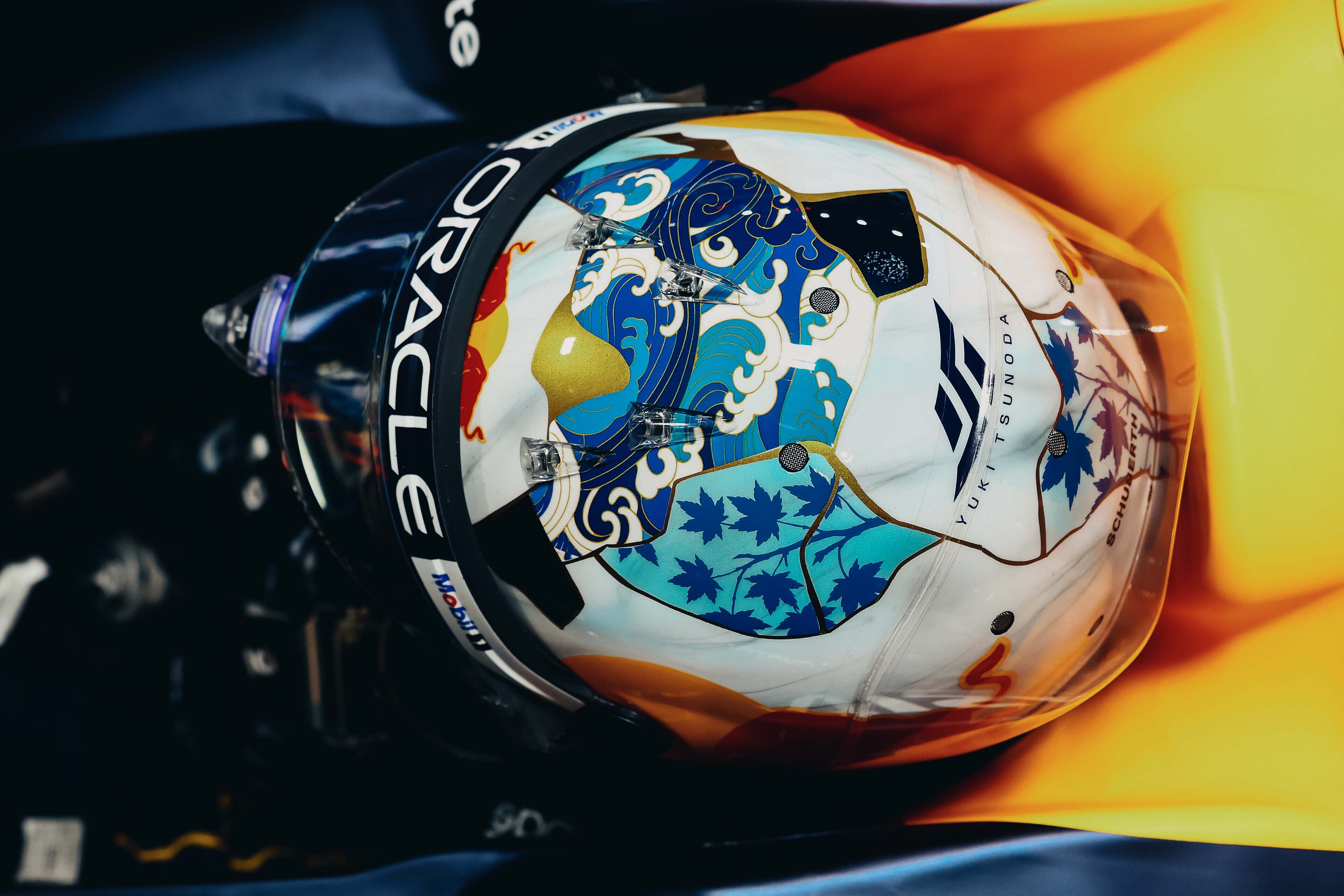
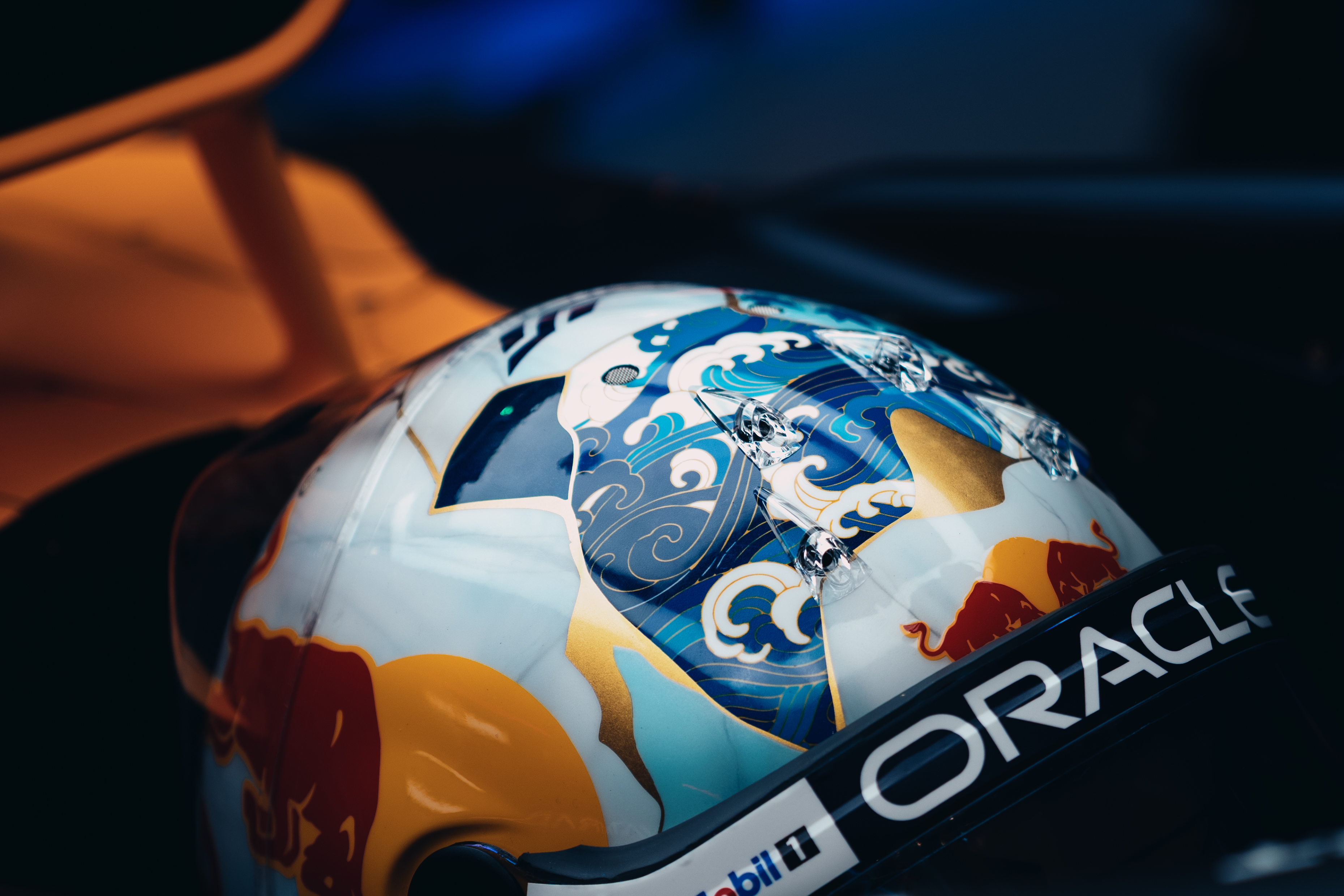
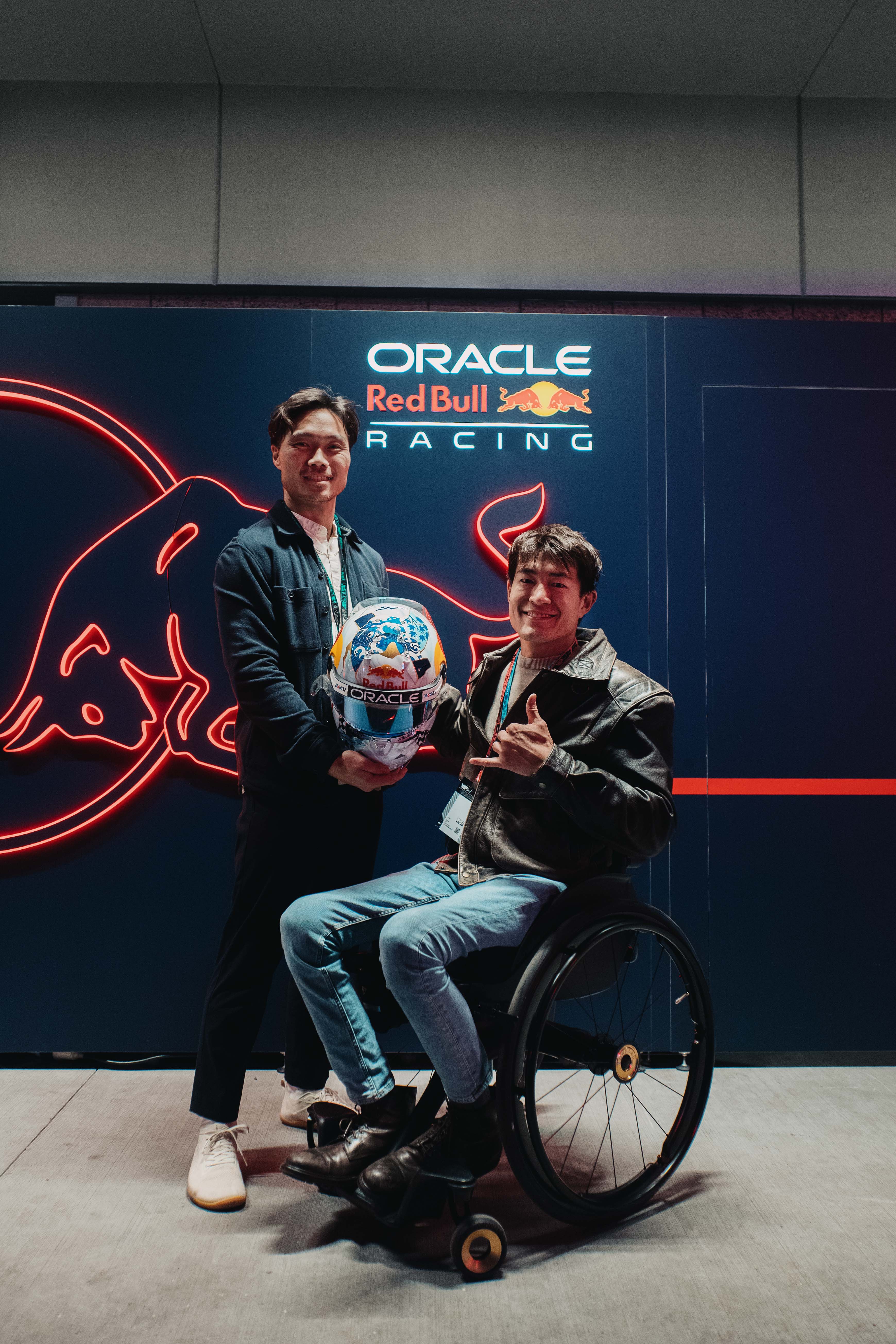
The gold “22” slides down the back, right between the Ukiyo-e style maple leaves and spinning clouds. There is white and blue and, of course, a leaping red bull, but it is the detail bisecting the images on the racing helmet that tells the story.
Neuro cofounders Ryan Chen and Kent Yoshimura had planned to hire a big-name artist to design Yuki Tsunoda’s 2025 Las Vegas Grand Prix helmet for them; someone with a social media following to amplify the branding opportunity. “Can we get Mr. Beast to design it?” Yoshimura remembers them asking, through a grin. But none of the work they saw spoke to them, so eventually, Yoshimura — Neuro’s creative director who also paints large-scale murals around the world — spent 36 straight hours designing it himself.
The gold lines between each image — a reference to the Japanese artisan tradition of Kintsugi, where cracked porcelain is glued back together with a gold lacquer to accentuate and celebrate the fracture — unlocked the design for him. The message spoke to Yuki as well. “I learned through Kent what Kintsugi is — it was a new piece of my culture that I was not aware of,” Yuki Tsunoda explains. “When I saw the completed helmet, it looked amazing. To be honest, it is my favorite helmet in my career.”
The Red Bull driver had just three races left on the grid in 2025. His custom helmet would animate a narrative of a new strength built from the struggle.
“It speaks to the human experience,” Yoshimura says. “As you go through life, you get these cracks and wrinkles and broken bones that allow you to become crafted and molded and sculpted into a much more defined human being.”
“And obviously all of us go through that journey, so it’s relatable to all of us,” he continues. “But for some it’s more visually obvious than for others.”
It was February 2009. Yoshimura still remembers exactly where he was when he heard the news. His best friend Ryan Chen was involved in a snowboarding accident. He had taken off from a jump on a run in Big Bear, California. Fell about 30 feet. His back was shattered.
Yoshimura and Chen were roommates at University of California, San Diego. They were athletes, obsessed with testing their limits. Yoshimura was a martial artist, training in Judo with the Japanese Olympic team and fighting Muay Thai in Thailand. Chen was a runner, excelling in track and cross country. They studied and played video games, like other teenagers, but they also crafted combinations of supplements to see how far they could push their bodies. They were chasing ways to maximize their energy, their endurance, their memory, and their focus.
Now, Chen lay in the trauma center at Loma Linda Hospital. He could not feel anything below his belly button. He had not wanted to panic his parents, but the doctors made it clear he needed loved ones around him. Soon, they told him that he would never walk again. He was 19 and all he had ever known and loved was on his feet, outdoors, in fifth gear. What the hell was life going to be like now?
Still, Chen stayed positive — he would be the one-in-a-million case people told stories about. He would endure, because he was an endurance athlete. He would make it. But then, a few weeks in, the nerve pain started. It was too much to bear, and it all came crashing down. All of a sudden, he “went from this optimistic kid to rock bottom.” He would ride a wheelchair forever. He would have to relearn how to do so many daily tasks, and on top of it all, he would have to deal with relentless nerve pain and back issues. But that was not the worst of it.
“Then you start thinking about the reality of my new life. Like, okay, like how do I get a job? Can I have kids? Can I have a family?” Chen remembers. “I gave myself a timeline: I’m going to power through for a year but if I can’t walk after a year then I’m going to give up. I contemplated suicide.”
But Yoshimura and his other friends kept showing up at the hospital. It was hours from campus, but they were there whenever they could be. And then when Chen returned to campus, they still kept rallying around him.
“I pushed myself to go to parties and social events, but I really didn’t want to do that. I just had this internal clock in my head,” he says. “Then, a year happened and I was like, ‘I’m going to give myself two years.’ And it really became, like, ‘How far can I kick the can down the road?’ Because I really don’t see a future for myself.”
Still, Chen endured. Eventually, finally, he started to see what life could be.
“There was a Groupon deal on scuba diving,” Chen tells me. “Kent was the first person I asked to join me.” This was in 2013, four years after the fracture. The seams of his life had started to harden again. Chen had found bits of gold and lacquer to rebuild himself with.
He had taken up handcycling and started doing wheelchair racing. He completed a few marathons. “I had this running career and instead of using my legs, now I’m using my arms,” he says. “But my cardio is the same.”
Yoshimura had kept up his martial arts training in earnest. He began fine-tuning his homemade supplements, and he would share them with Chen. It felt like the old days, before the fall that changed everything. “Next thing we know, we were on the boat, super tired, and that unlocked something for me,” Chen says. “I’m scuba diving, something a lot of people don’t do or are afraid to try. But I did it and the world opened up.”
Something else happened during that scuba trip, too. Chen and Yoshimura wanted to take their L-theanine, caffeine, and vitamin B6 and B12 nootropic pills on the boat, but it felt odd around the other divers. That is when they realized that supplements in gum and mint form could make their supplements both accessible underwater and shareable anywhere. So, it was a scuba trip that unlocked the possibility of a full life for Chen, and helped him and Yoshimura create Neuro Gum.
They were not sure what the response would be to their product; no one was chewing gum to improve working memory, sharpen focus, balance mood, and improve energy. But, soon enough, it was clear Chen and Yoshimura were onto something big.
They have been selling their nootropic products for 10 years now. They have been on Shark Tank, and had Steve Aoki and Apolo Ohno as ambassadors. Last year, they sold their 500 millionth piece of gum. They are creating their own category.
“The story of Neuro Gum is a story of resilience, friendship, and never giving up,” Chen says.
Right when Yuki tried Neuro Gum at the beginning of 2025, he wanted to partner with Chen and Yoshimura. It took some convincing to get the top brass at Red Bull on board. “Obviously, we couldn’t do energy because of Red Bull’s conflict,” Chen explains, “but we’re like ‘Dudes, we got focus, we got memory, we got sleep! There’s ways that we can work with this, right?’” Eventually, everything got squared and, in the spring of 2025, Yuki signed a partnership with Neuro at Liv Nightclub owner Dave Grutman house Miami. It was a perfect match: an F1 driver, who must obsess over every detail in 200 miles per hour traffic, and a memory-and-focus nootropic gum. Yoshimura and Chen were over the moon.
They tell me they knew Yuki loved the product, but it was not until months later that they realized how much he was all in on the brand. Yoshimura was in Alba, Italy — the truffle capital of the world — for a friend’s wedding and he and his wife took a day trip to a lake nearby. The town was tiny, with a population around 500, but all of a sudden they spotted a small Japanese man in a group of Italians. “Michelle, my wife, is like, ‘Oh my god, it’s Yuki!’ And so I’m like, ‘Yuki, what the hell?’ And he comes running over,” Yoshimura remembers through a gracious smile. “In Italy, he’s a superstar, so people are stopping him left and right. We just had a minute to chat, but he’s like, ‘Dude, I’m going to an AC Milan game tomorrow. Are you able to make it?’”
Of course, Yoshimura cleared his schedule to tag along, and got to witness the life of a beloved F1 driver up close. “His social media person was supposed to come down and shoot a bunch of stuff for him, but Yuki was like, ‘No, no, no. I want Kent to come down. Kent, just shoot the content,’” Yoshimura continues. “So I’m shooting content for Yuki, hanging out in the nicest area in the stadium where they’re serving Dom Pérignon.”
I ask if seeing Yuki in Italy, being treated like an icon, was a lightbulb moment for how powerful of a spokesperson he could be for Neuro. But both Yoshimura and Chen push back.
“It was more of an unlock for me to see that Yuki was, at the end of the day, just a 20-something-year-old kid,” Yoshimura says.
“He’s a human being,” Chen adds. “He’s a human being with a fucking crazy job!”
.jpg)

That crazy job tested the mental fortitude of that 20-something kid this last year. But to Yoshimura and Chen, there is no doubt that he will be stronger for the struggle.
Yuki instantly loved the aesthetic when he saw Yoshimura’s Vegas GP helmet design; but when he learned the deeper meaning, it all clicked. Chen had put himself together again, and then built Neuro into a massive brand with his best friend. Yuki had a thousand little cracks by the time he put the helmet on in November, but he too would return stronger. They were certain the message would resonate with Yuki’s fans, because it resonated with Yuki.
Chen and Yoshimura tell me they know Yuki’s story in racing is far from over. They can’t share any details now, but they are confident there will be more to tell soon. And they know the smallest driver on the grid will be a force when he gets back behind the wheel.
Because he has been chipped and nicked and shattered, just like everyone else; when he returns to the grid, he will be unbreakable at the spots where those cracks have healed.